At Voca Bee, we run simulations to understand how different daily review capacities affect vocabulary acquisition over time. Each simulation tracks word bank growth, daily review activity, and completion rates.
We simulated three learner profiles over 50 days:
- Slow Learner: Capacity of 12 reviews per day
- Normal Learner: Capacity of 20 reviews per day
- Fast Learner: Capacity of 55 reviews per day
Main highlight (unchanged): the word bank slowly grows based on the user’s learning capacity.
Two important dynamics visible in all charts:
- Early completion is low when the initial number of due cards is too high for the user’s capacity.
- Over time the adaptive word bank expansion throttles new cards based on user velocity. As the number of matured cards grows, daily new cards naturally goes lower to leave capacity to review matured cards that are becoming due.
- After the initial ramp, the completion rate is almost flat and consistent. That’s the signal that the system is staying in the “balanced zone”: it’s not overwhelming users with too many due cards, and it’s not underwhelming them with too little to do.
Slow Learner (Capacity: 12)
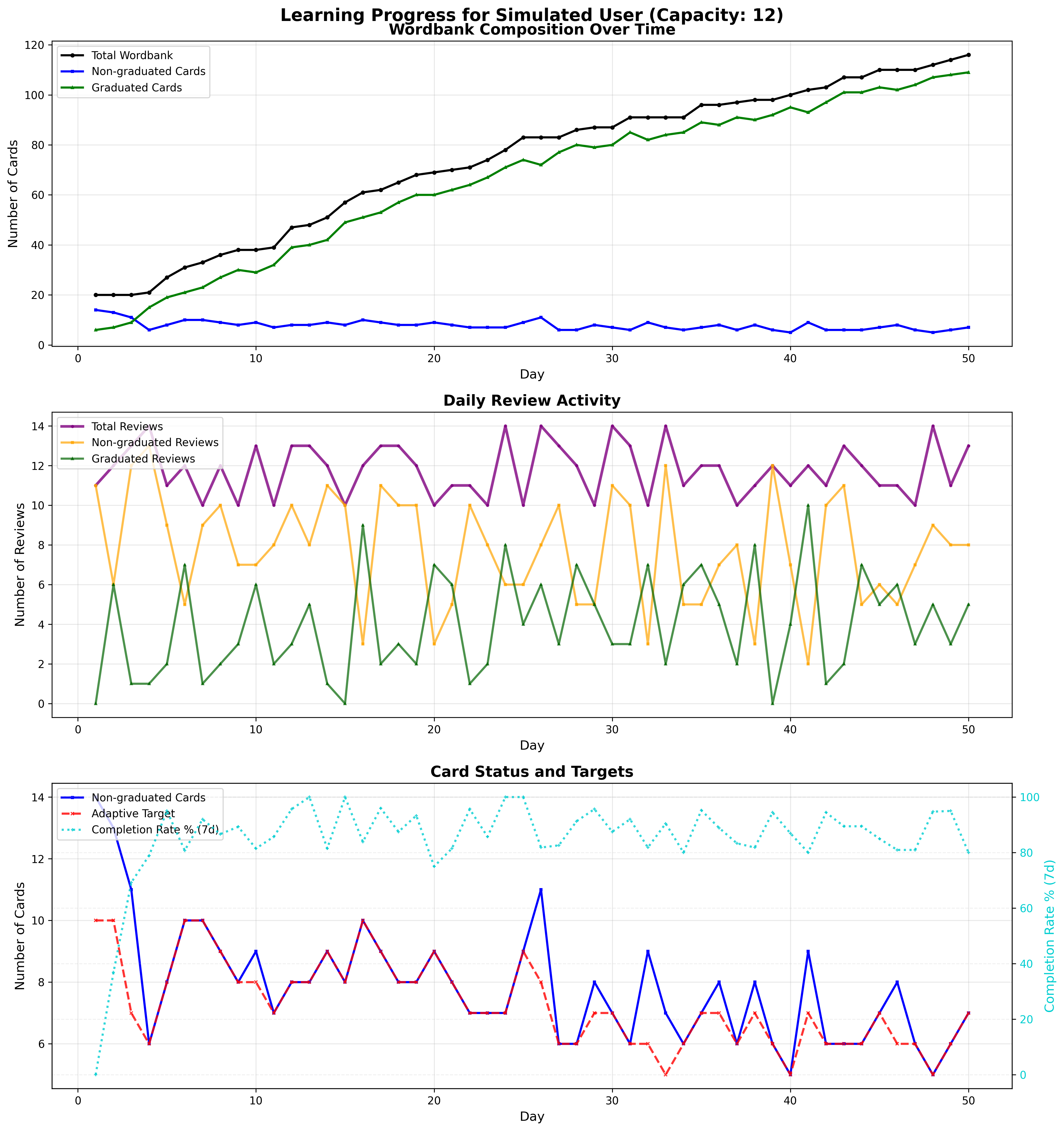
Wordbank Composition
Key Observations:- Total Wordbank (Day 50): 116
- Non-graduated cards (Day 50): 7
- Graduated cards (Day 50): 109
Even at 12 reviews/day, the system keeps the active learning queue (non-graduated cards) small and stable while the graduated pool grows. This is the mechanism behind “slow, sustainable” growth: new cards are introduced only as the user demonstrates capacity to absorb them.
Daily Review Activity
Key Observations:- Total reviews (50 days): 589 (avg 11.8/day)
- Non-graduated reviews: 390 (avg 7.8/day)
- Graduated reviews: 199 (avg 4.0/day)
The system does not prioritize “non-graduated” cards by design. It prioritizes urgency: in code, reviewed words are ordered by lowest retrievability first (most at risk of being forgotten). Never-reviewed words are pushed to the bottom and are only introduced when no reviewed words are due.
Card Status and Completion Rates
Key Observations:- Non-graduated cards: Stays small; ends at 7 on Day 50
- Adaptive Target: Tracks that non-graduated band (single digits to low teens)
- Completion Rate % (7d): Starts low, then rises and stays mostly high (see chart)
- The system keeps your “active learning” queue small so it stays doable
- Progress is steady: the word bank reaches 116 words in 50 days
Normal Learner (Capacity: 20)
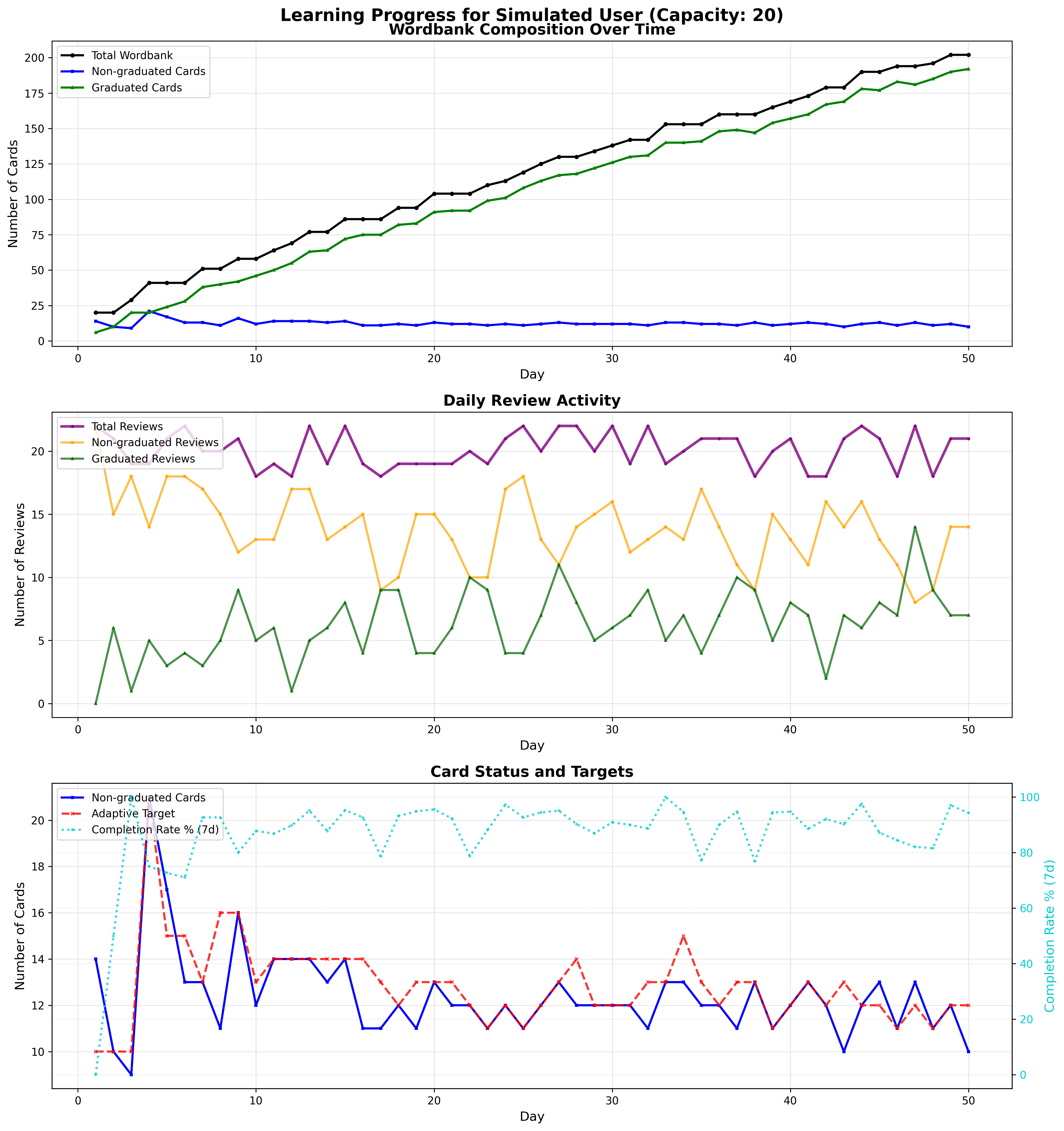
Wordbank Composition
Key Observations:- Total Wordbank (Day 50): 202
- Non-graduated cards (Day 50): 10
- Graduated cards (Day 50): 192
Capacity 20 hits a solid “cruise speed”: the non-graduated pool stays stable while the graduated pool grows steadily. As more cards mature, the system naturally reduces new introductions to reserve capacity for the graduated reviews that start coming due.
Daily Review Activity
Key Observations:- Total reviews (50 days): 1006 (avg 20.1/day)
- Non-graduated reviews: 694 (avg 13.9/day)
- Graduated reviews: 312 (avg 6.2/day)
Card Status and Completion Rates
Key Observations:- Non-graduated cards (Day 50): 10
- Adaptive Target: Closely tracks that band
- Completion Rate % (7d): Starts low, then stabilizes high (see chart)
- You get steady growth to 202 words without the queue blowing up
- The adaptive target stays close to the actual workload, which keeps completion high
Fast Learner (Capacity: 55)
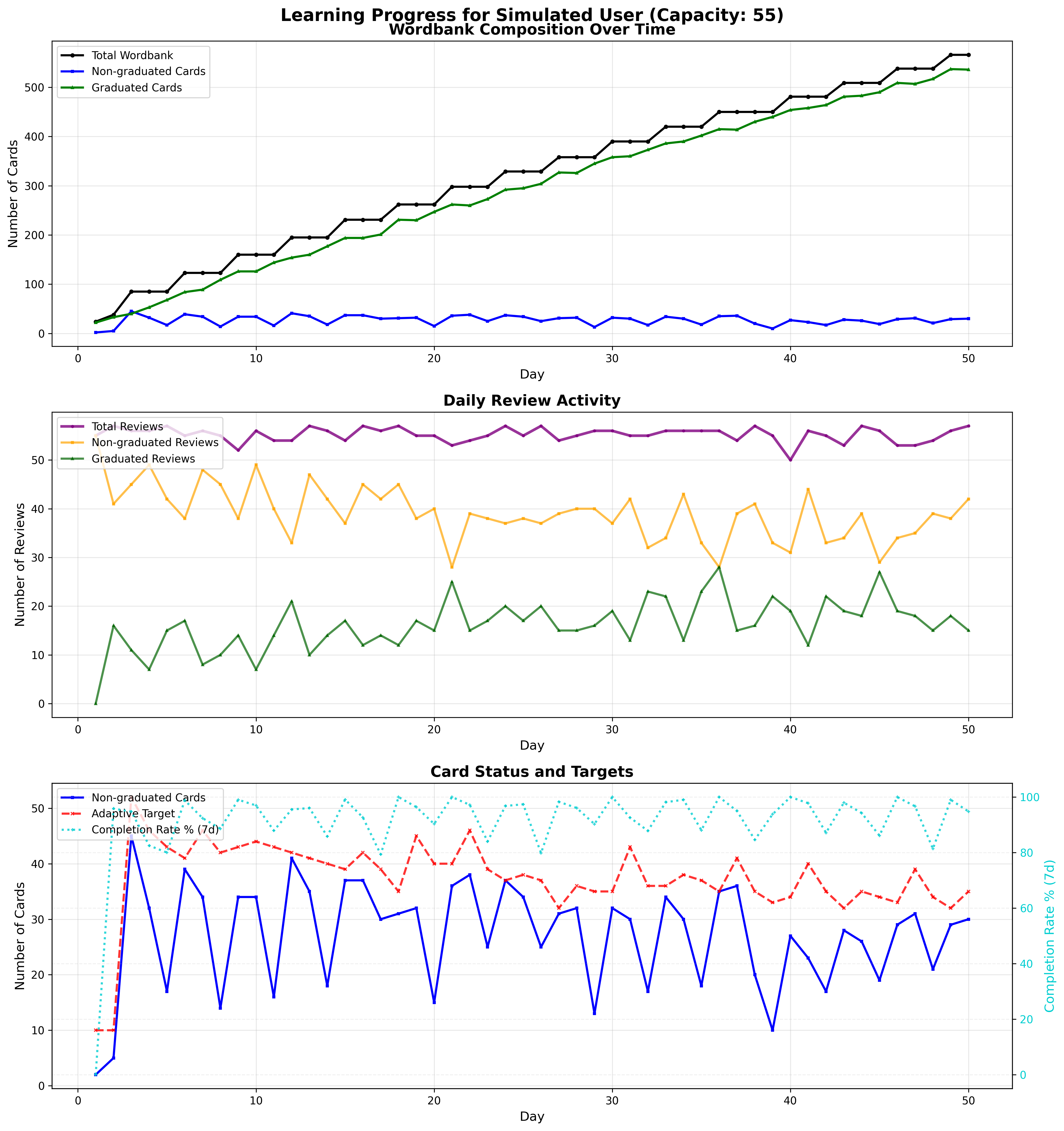
Wordbank Composition
Key Observations:- Total Wordbank (Day 50): 566
- Non-graduated cards (Day 50): 30
- Graduated cards (Day 50): 536
The main difference at capacity 55 is speed: the system can expand the word bank faster because the user can handle more daily reviews. Importantly, the system still throttles new introductions to keep space for matured reviews as they grow—so the workload stays sustainable even as the matured pool becomes large.
Daily Review Activity
Key Observations:- Total reviews (50 days): 2762 (avg 55.2/day)
- Non-graduated reviews: 1955 (avg 39.1/day)
- Graduated reviews: 807 (avg 16.1/day)
Card Status and Completion Rates
Key Observations:- Adaptive Target: Pretty stable throughout (this is especially visible for capacity 55)
- Completion Rate % (7d): Starts low, then remains mostly high (see chart)
- You get faster growth to 566 words with a stable target
- New introductions gradually ease as matured reviews become a bigger share of the daily load
Comparative Analysis: What the Simulations Reveal
Vocabulary Growth Rates
| Learner Type | Starting Cards | Ending Cards | Growth Factor | Cards Added/Day |
|---|---|---|---|---|
| Slow (12) | ~20 | 116 | ~5.8x | ~1.9/day |
| Normal (20) | ~20 | 202 | ~10.1x | ~3.6/day |
| Fast (55) | ~20 | 566 | ~28.3x | ~10.9/day |
Key Insight: Capacity directly correlates with vocabulary growth, but the system still enforces sustainable pacing by throttling new cards as matured reviews grow.
Non-Graduated Card Management
All three profiles maintain manageable non-graduated card pools:
- Slow (12): ends at 7
- Normal (20): ends at 10
- Fast (55): ends at 30
Completion Rate Patterns
Across all capacities:
- Low at the start when the initial queue exceeds capacity
- Improves quickly as adaptive word bank expansion adjusts new card introduction
- Then stays high and almost flat/consistent (see charts). This consistency is important: it indicates the system is keeping users in a steady daily workload band rather than oscillating between overload and “nothing to review.”
System Adaptability (What the code actually does)
- Review priority: reviewed words are prioritized by lowest retrievability first; never-reviewed words are introduced only when no reviewed words are due
- Adaptive expansion: new cards are introduced based on user velocity
- Matured load balancing: as matured cards grow, new introductions drop to preserve review capacity
- Stable targets at higher capacity: capacity 55 shows a notably stable target throughout
Implications for Learners
Finding Your Optimal Capacity
Your optimal capacity depends on:
- Available time: what you can do consistently
- Cognitive load: how much new material you can encode
- Consistency: whether you miss days (and need buffer)
- Goals: steady conversational progress vs faster expansion
Recommendations by Profile
If you're a Slow Learner (10–15 reviews/day):- Expect steady growth with a small, stable “active learning” queue
- The word bank still compounds to 116 words in 50 days
- Strong balance of progress and sustainability
- The word bank reaches 202 words in 50 days without overload
- Faster expansion with stable targets
- New introductions ease as matured reviews become a larger share
How Voca Bee Uses These Insights
These simulation results directly inform Voca Bee’s adaptive learning system:
- Review prioritization: lowest retrievability first for reviewed words
- Adaptive word bank expansion: adjust new card introduction based on user velocity
- Matured-card balancing: reduce daily new cards as matured reviews grow
- Target stability: keep targets stable once the system finds a sustainable equilibrium
Conclusion
Key Takeaways:- The word bank grows slowly based on each user’s learning capacity
- Completion starts low when the starting queue is too large, then rises as the system adapts
- After the ramp, completion rate is almost flat and consistent, meaning the system does not overwhelm nor underwhelm users
- As matured cards increase, daily new cards goes lower to preserve review capacity
- Capacity 55 shows a notably stable target throughout
Try Voca Bee at vocabee.noelcodes.com and let the system adapt to your pace.